Troubleshooter is the third in the Ruthless to Win series of books set around Armitage motor racing company. All the books in this series are first person POV of one of the characters, so you kind of get to know everyone bit by bit.
This story is Charlie Cartwright's. Charlie is Armitage's troubleshooter and the trouble he needs to shoot in this story is the team's Formula 1 driver, who is a bit of a party animal and cocaine smuggler.
Charlie meets his soul mate at the start of this story and being in love does somewhat distract him. But as with the other books, everyone is superb at their jobs, they have massive expense accounts and work all the hours under the sun.
Even though this is set in a man's world, as a female reader, I didn't find it too technical or too "mannish". The jet-setting and behind the scenes at races were interesting enough, but not too detailed as to put me off. It was a good adventure.
http://www.amazon.co.uk/dp/B008U5MZ32/?tag=jookuf-21
Showing posts with label Dakota Franklin. Show all posts
Sunday, 23 June 2013
Monday, 12 November 2012
Le Mans by Dakota Franklin
Le Mans is the author's first book in her Ruthless To Win series, set in and around the motor racing world. I read book 2 first so knew a little about these characters. As I understand it, each book will be set around a different character, but all in the same world of "Cartwright-Armitage" racing.
Sometimes the story got a bit bogged down in technicalities, but other readers might like it .
I also think that the characters are bit "too nice to be true". The world that Mallory finds herself in with money thrown at everything, expensive gifts are given left, right and centre seems a bit too wonderful. OR is that I don't know of these things and life really is like that in the world of top-class motor sports :)
I do like this world that Dakota Franklin has created. The books are an easy clean read with strong female characters. There were no profanities in the book and even though you'd imaging the male world of motor sports would be full of rough people, Cartwright-Armitage are the gentlemen of this world.
www.amazon.co.uk/dp/B006NUB1HC/?tag=jookuf-21
Sometimes the story got a bit bogged down in technicalities, but other readers might like it .
I also think that the characters are bit "too nice to be true". The world that Mallory finds herself in with money thrown at everything, expensive gifts are given left, right and centre seems a bit too wonderful. OR is that I don't know of these things and life really is like that in the world of top-class motor sports :)
I do like this world that Dakota Franklin has created. The books are an easy clean read with strong female characters. There were no profanities in the book and even though you'd imaging the male world of motor sports would be full of rough people, Cartwright-Armitage are the gentlemen of this world.
www.amazon.co.uk/dp/B006NUB1HC/?tag=jookuf-21
Friday, 20 April 2012
Interrogating Dakota Franklin
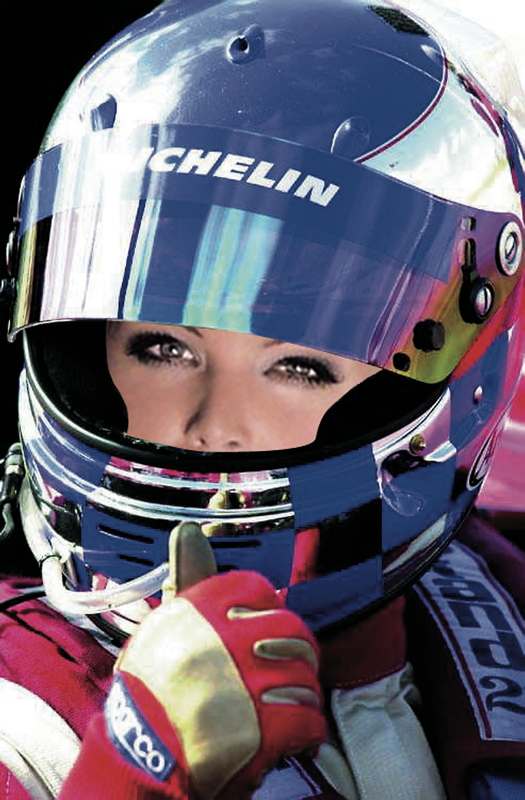
My next interview is with the owner of these gorgeous eyes, Dakota Franklin. And quite frankl(in)y I was exhausted just reading it. Dakota has a new book just out "Requiem at Monza" which is a cracking good read.
How do you strike the balance between writing something you want to write and writing something that people want to read, in terms of the compromises you make, if any?
I make no compromises. My day job — high performance engineering development — is making things other people designed better; it is not primarily creative. I write to express a creative urge. I spend the money on hiring the finest teacher of creative writing in the world, André Jute, because I like doing things well. But the only people whose opinions matter to me are Ferry and Giselle, my husband and daughter, and André. I wouldn't even publish my books except that André takes such a hard line on a writer not being a writer until she submits herself to the test of publication that he threatened to drop me if I continued to stack up the books in the proverbial bottom drawer.
What excites, attracts or appeals to you about the genre(s) you write in?
I don’t see myself as a genre writer. I write novels about characters who must find a solution to their problems. That the novels I write are novels of suspense, or thrillers if you prefer, is merely a matter of how I structure them for the most efficient use of space with the maximum impact. But I don’t set out to write thrillers, or any other specific genre. All my stories so far are romances too…
I’ll tell you a secret. At first I wrote crime stories, simply because they were set in a different world to mine. I found that exciting for a while. But Andre, when he eventually took me on, made me throw out the three complete novels I had. I could see they were derivative. Their lack of originality didn’t bother me, as I didn’t think about publication at all. But Andre worked with me until I grasped that seeking my stories in a crime environment, while exciting for its novelty, wasn’t liberating me, but instead restricting me because I had to research everything. The ratio was shocking, eight hours of research for an hour of writing. I was wasting my time.
He persuaded me instead to write about the world that I do know, in which I work. At first I was resentful, but then, as I started to grasp his central message that to be a first class writer one must in the first instance concentrate on the characters, not the environment or the situation (the plot), I found I was liberated and the books started to flow, at the rate of about one big novel a year. For a writer whose time is as tightly scheduled as mine, and whose family must always come first, that is quite an exceptional output.
Once I came to be at ease with my new teacher (I worked with a couple of others before and they were useless) and my new mental world, half imaginary, half real, I found it made my day job so much more enjoyable, because I was looking at it through new eyes. It worked both ways, because I started seeing, really seeing, the people I worked with as human beings and not just number crunchers (they’re mostly engineers) of greater or lesser numerical ability. Of course, it helped my work tremendously that they started responding to me as a person, because I saw them as persons. Then I started seeing that there were fascinating characters all about me, like cherries on a tree, waiting to be picked, and I knew I wasn’t ever returning to the hard slog of crime writing.
So, yes, I find my subject material intensely exciting and hugely liberating. Unlike other writers, I never have to reach for a subject for my next book. I just choose from among the characters, and with the character comes his or her problem, and that’s the beginning of an involving story.
Do you have a box, drawer, folder etc where you keep thoughts and ideas for future stories? Such as names you have come across, bits of dialogue, ideas, characters - even if you have no idea when you might use them?
Rather than a big commonplace book, I keep a folder on my computer and when a character occurs to me, he or she comes accompanied by a book title, so I write down the title and perhaps an opening paragraph. This is very helpful, because when I’ve finished one book, after a short break I start writing a chapter or two of each of these ideas, until the right one announces itself to me because I just keep going with it until I come to the end of the story.
How much of you is in your characters? Which of your characters is the you that you’d most like to be? Or be with ?
Ha! Most people would probably consider me a bit dull. I work a 12 to 14-hour day, and have since I finished high school. My work is mostly meetings with men in white coats in workshops or labs, everybody standing, or in offices with men in suits. My closest friends, outside my family, are the lawyer, stenographer and personal assistant who travel with me in my car and on the plane; I’m with them five days a week, and they’re the first critics of everything I write, because I dictate my stories in the car. I buy my plain black suits and plain white blouses two dozen sets at a time so that I don’t waste time choosing clothes at 4.45am when I roll out of bed and need to hit the autobahn in fifteen minutes to make my first appointment of the morning in a motor city possibly deep into Germany (I live in Switzerland). In that respect I’m like Lydia Simpresi, and like hers, my manner is a good deal more modest than my achievements entitle me to, because as a woman in a man’s profession I’ve learned that confrontation wastes time. (If you want to know what I wear over weekends, I wear my daughter’s castoffs. I’m the trendiest mum for three hundred klicks in any direction! Ferry says it is disgusting how young men hardly out of their teens look at me with puppy eyes.)
So I suppose I’m a bit like Mallory too, in LE MANS a novel, and like her, German engineers like me.
But I know that, given the opportunity, I could be an extrovert like some of my characters, Flicka Revere for instance, the lesbian racer in NASCAR FIRST, or Thrill Morgan in TRIPLE THREAT THRILL, who tells a competitor on a racetrack, “Kiss my ass, kiss my ass again, then kiss my ass goodbye.” Or some of the male lead characters, the talented sculptor Raf Ferenghetti, in QUEEN OF INDY, for instance. Or I’d like to be not just another blond bimbo but to have exciting Nefertiti looks like his girlfriend the fast-rising racing operations manager Sally Samson.
Do you become so wrapped up in your writing that your spouse wonders if they're married to you or one of your characters?
Ferry, my husband, is an inventor. He can sit for months looking out of the window at the mountain. Then, after he has an idea, he can be in his workshops for more months. Our daughter, Giselle, and her best friend have desks in Ferry’s study and in each of his workshops, where they sit to do their homework. (Ferry is forbidden to help them. Those two girls can twist him around their little fingers to do their whole projects for them.) The best friend is the daughter of teachers at Giselle’s school; they live in a house in our compound and take the girls to and from school. Our housekeeper sees that Ferry and the girls don’t eat junk food rather than proper meals. Between the families in the compound they speak 21 languages, so Giselle and her friend are linguists who commune in a patois they think nobody else can understand. They’re going to be UN translators and travel free around the world, they say.
So you can see, the entire family is a bit flaky. In fact, since I do all my writing in the car or on the plane, I’m the most “normal” one. I’m home most evenings by 7pm and we eat at 8pm, then watch a movie or listen to music or just talk. I learned to sew from my granny, so currently the two girls and I are making dresses for them to wear to a ball for well-bred young ladies. (Well, not to tell a lie: young ladies who swear only in obscure languages.) Ferry has this dark vision of our sewing not being up to energetic dancing and the girls standing there blushing in their underclothes with our sewing in a puddle about their feet. So now they have a project in a workshop to test seams. If I put any of that in a novel, people would think me weird…
What type of book do you like reading? Is it the same genre as you write?
I like well-written novels of suspense. I like children’s and teenagers’ classics. I was delighted at the opportunity having a child brought with it of reading all my favourites again with Giselle as she reached an appropriate age.
What lengths do you go to convince us readers that your book has the X factor?
None. My publisher may care about readers for turnover, and Andre, who is also my editor, may care about readers as a score-keeping exercise, but I don’t care about the number of readers, or sales, at all. I’m delighted when I attract nice readers, of course, and meet them in the fora, but I won’t change anything to attract or keep readers. I just tune out talk you run into on the fora about the “right commercial thing for a writer to do”. To give you an idea of how silly the conceit is that a writer can tailor how many readers she has, when the price of LE MANS a novel was increased from $2.99 to $9.99 — the sales went up! According to Gemma Coole, my publisher, there are over 5000 copies of LE MANS a novel out there. That’s more than enough for me. My books will get the number of readers they deserve, and we will be happy together.
How do you feel when a reader points out the spelling mistake(s) you have made?
They should speak to my stenographer, to the programmers of my dictation program (Dragon), to my publishers at info at coolmainpress dot com, and to my editors (bless them) at Andre’s Editorial Menagerie (where I’m not permitted to enter) http://www.goodreads.com/group/show/57773.Andre_s_Editorial_Menagerie I wish them luck in finding the responsible party!
What do you like most about visiting KUF?
That the people here are so much nicer than on the wretched Amazon book fora.
What is on your near horizon?
More of the same. I’m fulfilled in my two careers and with my family. There is nothing I want to change, nothing I want that I don’t have already. At the moment I’m idling, enjoying the excitement of launching REQUIEM AT MONZA. Next I’ll probably be writing about Henry, who gives his jacket to Mallory at Monza, as he becomes an English duke and steps up a class as a racer; it is ostensibly a book about a libel suit, and a baddie who beats women.
Where can we find you for more information?
Amazon UK: http://www.amazon.co.uk/s/ref=ntt_athr_dp_sr_1?_encoding=UTF8&search-alias=digital-text&field-author=Dakota%20Franklin
publisher: http://coolmainpress.com/dakotaruthlessseries.html
bio: http://coolmainpress.com/Dakota%20Franklin.html
email: dakotafranklin@coolmainpress.com
facebook: http://www.facebook.com/profile.php?id=100003208437090
twitter: https://twitter.com/#!/thrillsdakota
How do you strike the balance between writing something you want to write and writing something that people want to read, in terms of the compromises you make, if any?
I make no compromises. My day job — high performance engineering development — is making things other people designed better; it is not primarily creative. I write to express a creative urge. I spend the money on hiring the finest teacher of creative writing in the world, André Jute, because I like doing things well. But the only people whose opinions matter to me are Ferry and Giselle, my husband and daughter, and André. I wouldn't even publish my books except that André takes such a hard line on a writer not being a writer until she submits herself to the test of publication that he threatened to drop me if I continued to stack up the books in the proverbial bottom drawer.
What excites, attracts or appeals to you about the genre(s) you write in?
I don’t see myself as a genre writer. I write novels about characters who must find a solution to their problems. That the novels I write are novels of suspense, or thrillers if you prefer, is merely a matter of how I structure them for the most efficient use of space with the maximum impact. But I don’t set out to write thrillers, or any other specific genre. All my stories so far are romances too…
I’ll tell you a secret. At first I wrote crime stories, simply because they were set in a different world to mine. I found that exciting for a while. But Andre, when he eventually took me on, made me throw out the three complete novels I had. I could see they were derivative. Their lack of originality didn’t bother me, as I didn’t think about publication at all. But Andre worked with me until I grasped that seeking my stories in a crime environment, while exciting for its novelty, wasn’t liberating me, but instead restricting me because I had to research everything. The ratio was shocking, eight hours of research for an hour of writing. I was wasting my time.
He persuaded me instead to write about the world that I do know, in which I work. At first I was resentful, but then, as I started to grasp his central message that to be a first class writer one must in the first instance concentrate on the characters, not the environment or the situation (the plot), I found I was liberated and the books started to flow, at the rate of about one big novel a year. For a writer whose time is as tightly scheduled as mine, and whose family must always come first, that is quite an exceptional output.
Once I came to be at ease with my new teacher (I worked with a couple of others before and they were useless) and my new mental world, half imaginary, half real, I found it made my day job so much more enjoyable, because I was looking at it through new eyes. It worked both ways, because I started seeing, really seeing, the people I worked with as human beings and not just number crunchers (they’re mostly engineers) of greater or lesser numerical ability. Of course, it helped my work tremendously that they started responding to me as a person, because I saw them as persons. Then I started seeing that there were fascinating characters all about me, like cherries on a tree, waiting to be picked, and I knew I wasn’t ever returning to the hard slog of crime writing.
So, yes, I find my subject material intensely exciting and hugely liberating. Unlike other writers, I never have to reach for a subject for my next book. I just choose from among the characters, and with the character comes his or her problem, and that’s the beginning of an involving story.
Do you have a box, drawer, folder etc where you keep thoughts and ideas for future stories? Such as names you have come across, bits of dialogue, ideas, characters - even if you have no idea when you might use them?
Rather than a big commonplace book, I keep a folder on my computer and when a character occurs to me, he or she comes accompanied by a book title, so I write down the title and perhaps an opening paragraph. This is very helpful, because when I’ve finished one book, after a short break I start writing a chapter or two of each of these ideas, until the right one announces itself to me because I just keep going with it until I come to the end of the story.
How much of you is in your characters? Which of your characters is the you that you’d most like to be? Or be with ?
Ha! Most people would probably consider me a bit dull. I work a 12 to 14-hour day, and have since I finished high school. My work is mostly meetings with men in white coats in workshops or labs, everybody standing, or in offices with men in suits. My closest friends, outside my family, are the lawyer, stenographer and personal assistant who travel with me in my car and on the plane; I’m with them five days a week, and they’re the first critics of everything I write, because I dictate my stories in the car. I buy my plain black suits and plain white blouses two dozen sets at a time so that I don’t waste time choosing clothes at 4.45am when I roll out of bed and need to hit the autobahn in fifteen minutes to make my first appointment of the morning in a motor city possibly deep into Germany (I live in Switzerland). In that respect I’m like Lydia Simpresi, and like hers, my manner is a good deal more modest than my achievements entitle me to, because as a woman in a man’s profession I’ve learned that confrontation wastes time. (If you want to know what I wear over weekends, I wear my daughter’s castoffs. I’m the trendiest mum for three hundred klicks in any direction! Ferry says it is disgusting how young men hardly out of their teens look at me with puppy eyes.)
So I suppose I’m a bit like Mallory too, in LE MANS a novel, and like her, German engineers like me.
But I know that, given the opportunity, I could be an extrovert like some of my characters, Flicka Revere for instance, the lesbian racer in NASCAR FIRST, or Thrill Morgan in TRIPLE THREAT THRILL, who tells a competitor on a racetrack, “Kiss my ass, kiss my ass again, then kiss my ass goodbye.” Or some of the male lead characters, the talented sculptor Raf Ferenghetti, in QUEEN OF INDY, for instance. Or I’d like to be not just another blond bimbo but to have exciting Nefertiti looks like his girlfriend the fast-rising racing operations manager Sally Samson.
Do you become so wrapped up in your writing that your spouse wonders if they're married to you or one of your characters?
Ferry, my husband, is an inventor. He can sit for months looking out of the window at the mountain. Then, after he has an idea, he can be in his workshops for more months. Our daughter, Giselle, and her best friend have desks in Ferry’s study and in each of his workshops, where they sit to do their homework. (Ferry is forbidden to help them. Those two girls can twist him around their little fingers to do their whole projects for them.) The best friend is the daughter of teachers at Giselle’s school; they live in a house in our compound and take the girls to and from school. Our housekeeper sees that Ferry and the girls don’t eat junk food rather than proper meals. Between the families in the compound they speak 21 languages, so Giselle and her friend are linguists who commune in a patois they think nobody else can understand. They’re going to be UN translators and travel free around the world, they say.
So you can see, the entire family is a bit flaky. In fact, since I do all my writing in the car or on the plane, I’m the most “normal” one. I’m home most evenings by 7pm and we eat at 8pm, then watch a movie or listen to music or just talk. I learned to sew from my granny, so currently the two girls and I are making dresses for them to wear to a ball for well-bred young ladies. (Well, not to tell a lie: young ladies who swear only in obscure languages.) Ferry has this dark vision of our sewing not being up to energetic dancing and the girls standing there blushing in their underclothes with our sewing in a puddle about their feet. So now they have a project in a workshop to test seams. If I put any of that in a novel, people would think me weird…
What type of book do you like reading? Is it the same genre as you write?
I like well-written novels of suspense. I like children’s and teenagers’ classics. I was delighted at the opportunity having a child brought with it of reading all my favourites again with Giselle as she reached an appropriate age.
What lengths do you go to convince us readers that your book has the X factor?
None. My publisher may care about readers for turnover, and Andre, who is also my editor, may care about readers as a score-keeping exercise, but I don’t care about the number of readers, or sales, at all. I’m delighted when I attract nice readers, of course, and meet them in the fora, but I won’t change anything to attract or keep readers. I just tune out talk you run into on the fora about the “right commercial thing for a writer to do”. To give you an idea of how silly the conceit is that a writer can tailor how many readers she has, when the price of LE MANS a novel was increased from $2.99 to $9.99 — the sales went up! According to Gemma Coole, my publisher, there are over 5000 copies of LE MANS a novel out there. That’s more than enough for me. My books will get the number of readers they deserve, and we will be happy together.
How do you feel when a reader points out the spelling mistake(s) you have made?
They should speak to my stenographer, to the programmers of my dictation program (Dragon), to my publishers at info at coolmainpress dot com, and to my editors (bless them) at Andre’s Editorial Menagerie (where I’m not permitted to enter) http://www.goodreads.com/group/show/57773.Andre_s_Editorial_Menagerie I wish them luck in finding the responsible party!
What do you like most about visiting KUF?
That the people here are so much nicer than on the wretched Amazon book fora.
What is on your near horizon?
More of the same. I’m fulfilled in my two careers and with my family. There is nothing I want to change, nothing I want that I don’t have already. At the moment I’m idling, enjoying the excitement of launching REQUIEM AT MONZA. Next I’ll probably be writing about Henry, who gives his jacket to Mallory at Monza, as he becomes an English duke and steps up a class as a racer; it is ostensibly a book about a libel suit, and a baddie who beats women.
Where can we find you for more information?
Amazon UK: http://www.amazon.co.uk/s/ref=ntt_athr_dp_sr_1?_encoding=UTF8&search-alias=digital-text&field-author=Dakota%20Franklin
publisher: http://coolmainpress.com/dakotaruthlessseries.html
bio: http://coolmainpress.com/Dakota%20Franklin.html
email: dakotafranklin@coolmainpress.com
facebook: http://www.facebook.com/profile.php?id=100003208437090
twitter: https://twitter.com/#!/thrillsdakota
Labels:
Dakota Franklin,
Interview,
KUF
Tuesday, 17 April 2012
Requiem at Monza by Dakota Franklin
This is the second book in the "Ruthless to Win" series. I haven't yet read the first one "Le Mans" but I didn't feel like I was missing lots of important information. As far as I can tell, all the books in this series will be set in the same world of motor racing with a family of characters, but will all be different stories with a different area and different main characters, the other ones just "walk ons".
This book seemed to be a lengthy one. The plot was about a racing car crash, and the investigation into what caused it in the murky world of the Italian Camorra.
I thought the characters were great. I felt the story dragged a bit for the first part of the book, however as it progressed and got more into action, then I was swept along. I shall definitely bump Le Mans up my list now.
This book seemed to be a lengthy one. The plot was about a racing car crash, and the investigation into what caused it in the murky world of the Italian Camorra.
I thought the characters were great. I felt the story dragged a bit for the first part of the book, however as it progressed and got more into action, then I was swept along. I shall definitely bump Le Mans up my list now.
Labels:
Dakota Franklin
Subscribe to:
Posts (Atom)